|
 ONT
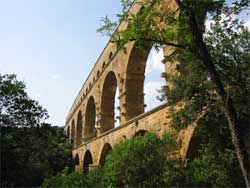
DU GARD, near Nimes, France. ONT
DU GARD, near Nimes, France.
This aqueduct
spans the river valley of the Gard. It was built by Agrippa and
served as a bridge capable of taking chariots as well as men.
DIMENSIONS:
- HEIGHT:
160 feet (49m)
- LENGTH:
895 feet (273m)
Historical
Background
 As
early as 1200BC Nimes (the Roman Nemausus), in the south of Gaul,
was under Roman control, but it was mainly in the time of Augustus
that it flourished. In 27BC the town was raised to the status of
a colonia by Augustus, and in 20-19BC Agrippa took a particular
interest in the town and surrounding area. It is to this period,
ca.19BC, that the Pont du Gard probably belongs. Nimes is also the
home of the Maison Carree As
early as 1200BC Nimes (the Roman Nemausus), in the south of Gaul,
was under Roman control, but it was mainly in the time of Augustus
that it flourished. In 27BC the town was raised to the status of
a colonia by Augustus, and in 20-19BC Agrippa took a particular
interest in the town and surrounding area. It is to this period,
ca.19BC, that the Pont du Gard probably belongs. Nimes is also the
home of the Maison Carree
Engineering
Although a
natural spring existed within the city's walls, it proved necessary
to supplement its supply of water by constructing an aqueduct, of
which the Pont du Gard is a small part.
- It brought
water to Nimes from another useable spring almost 31 miles (50km)
away to the north.
- Much of the
aqueduct was actually subterranean, and carefully built with a
very gradual drop of about 1 in 3000 over its entire length.
- This use
of a simple gravitational flow avoided the expense of installing
pressure systems to channel water over obstacles.
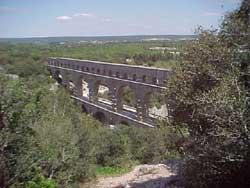 At
one stage the aqueduct had to bridge the river Gardon (or Gard),
about 13 miles (21km) north-east of Nimes, and here it becomes the
impressive monument to Roman engineering that survives today, with
some restorations and additions (notably the 18th century bridge-road
on the east side. At
one stage the aqueduct had to bridge the river Gardon (or Gard),
about 13 miles (21km) north-east of Nimes, and here it becomes the
impressive monument to Roman engineering that survives today, with
some restorations and additions (notably the 18th century bridge-road
on the east side.
Composition
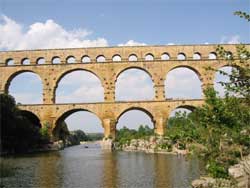
The arches which
span the main current in the two lower stories were made wider (24.5m)
than their neighbors on either side
they are surmounted by four, rather than three, of the small arches
in the top story.
There are:
- six arches
in the lowest story
- eleven in
the second
- thirty-five
in the top
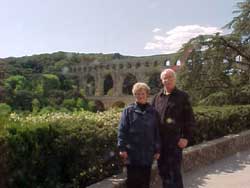 |
Peg
& Cliff at Pont du Gard |
Those in the
top level consist of one arch (10' [3.06m] deep), presenting a relatively
narrow face to minimize wind stress at this height .
The second level
has vaults each made of three parallel arches (15' [4.56m] deep),
one set behind another.
At the bottom
level, the vaults are made up of four parallel arches (21' [6.36m]
deep), to withstand the river's currents
This method
of juxtaposed parallel arches represents an economizing measure,
since only one timber framework was necessary for the construction
of each vault to support each arch as it was built. Repairs on the
upper arches could be carried out by setting a timber framework
on bosses which were left on the arches for this purpose.
Unlike most
later arches and vaults those of Pont du Gard were made of un cemented
masonry: The stone was quarried locally.
Pont Du Gard-
over its 31 mile (50km) length (from Uzes to Nimes) there is a difference
in height of only 56 feet (17m).
On
to the house.
<-
Back | Next
->
Home | Previous
Page |